

creative cross-training
I regret to say that learning to draw/paint might just make you a better writer

If I had made a Bingo board with predictions for 2025, it would not have had “start a regular art practice” on it. Just look at the opening of this post from late 2024!
Sunday fun: you should be making collages out of stickers

Are you a person who longs to be artsy but lacks any, you know, talent? I feel you.
But then something changed. And I’m so grateful, for reasons I’ll get to in a bit. But first, here’s the story.
Looking back, I think it started when I was shopping for holiday gifts for my kids and saw a cute travel watercolor set with a sketchbook and cover and thought, hmmm. I didn’t get it, but the seed was planted, and a little while later I bought a small watercolor palette and some paper and started painting. I had no idea what the hell I was doing and was pretty bad at it.
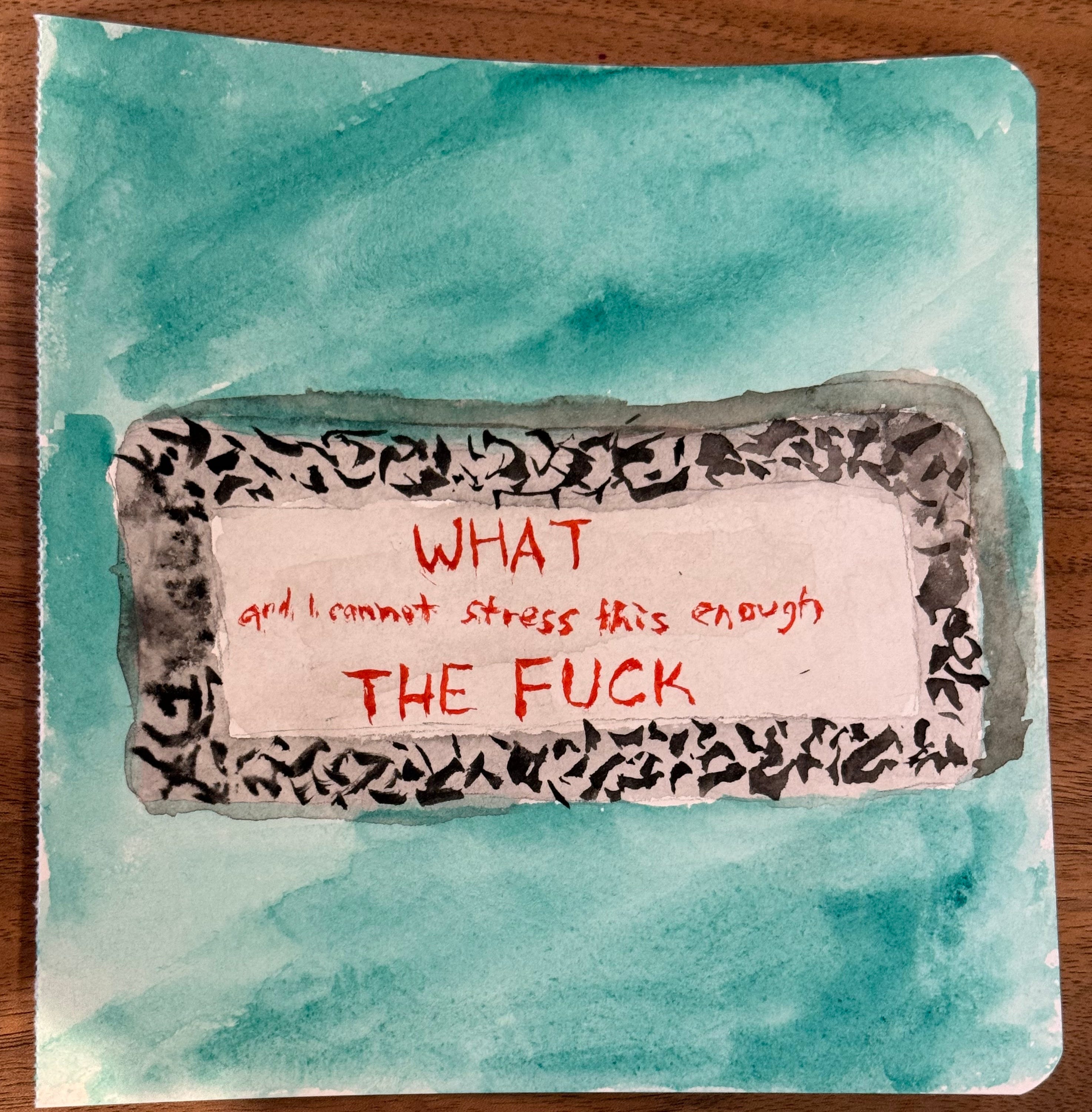
In the past that definitely would have been where this journey stopped, because as a recovering gifted kid, I really struggle with doing things that I’m bad at. Between that and my time in academia, which taught me that you should never open your mouth if you might be wrong or show someone work that is less than 100% polished, I’ve got some pretty serious baggage in this area. Just last week I was at a fun, friendly, intensely competitive friends-and-family quiz bowl night and I realized just how hard it is for me to open my mouth unless I’m 100% bulletproof sure I know the answer. An eleven-year-old beat me on a question about Greek mythology, the literal topic of my expertise that this newsletter is about. Yup.
One of the hardest parts about picking up a hobby as an adult is that you swiftly run face-first into the inevitable gap between your taste and your ability. Kids don’t have this problem, mostly. Some are perfectionists from birth. But most don’t really know what “good” art is, so they dgaf if their rainbows are wonky as hell. They sing at the top of their lungs even when they have no pitch. They don’t obsess about spelling and grammar. Something to aspire to, honestly.
But because I had impulse-purchased a bunch of art subscription boxes during a wave of existential despair following the inauguration in January, I couldn’t immediately drop this new hobby the moment I realized I was bad at it. And I got better much faster than I expected to, which was surprising and gratifying. There’s probably a lesson there about all the hobbies I’ve abandoned in the last twenty years, but I’m not going to think about it too hard for sanity reasons.


I’ve been traveling a lot this month, which is why I haven’t been updating this newsletter as regularly. (I figured you’d all welcome the inbox break.) Normally I’m pretty bad at journaling when I travel, even if I’m in the practice of regularly doing morning pages at home. But this time I’ve been loving using art to document my travels. I spent a week in Greece, and it was so much fun to paint what I saw. I regret to say that everyone who has said that sketching your travels helps you experience them on a different, deeper level was completely right. I’m so sorry.
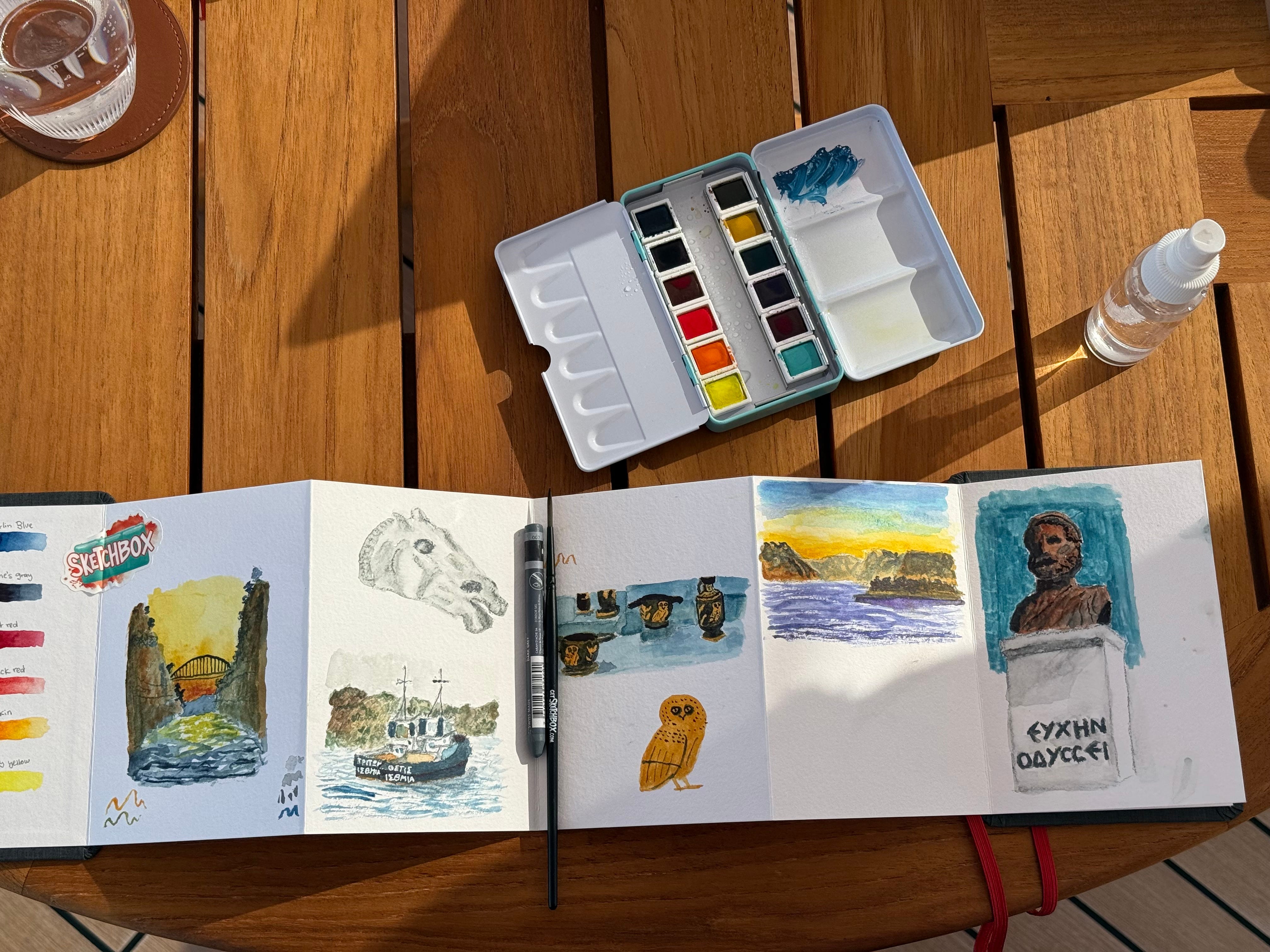
I’ve been thinking a lot about why this practice has been so meaningful for me, and I think there are two major reasons. And if you’re a writer, both of them might help you!
I started making art when I needed a creative outlet during a break from working on my book. My manuscript was with my editor, and the #1 rule of having material with your editor is: DON’T FUCK WITH IT. The last thing you want is to end up having to reconcile two different manuscripts.
But then all of the anti-trans executive orders started coming through, on a pretty much weekly basis, and not working on my book became downright excruciating. So I painted instead, and honestly, it helped a lot emotionally. I cannot recommend it enough.
Art has also helped me access something I thought I had lost, or maybe never had: a softness, or earnestness, or vulnerability. Like many millennials, I’m a little bit irony-poisoned by nature. In the first draft of my memoir every time I came close to having a feeling I deflected it with either a sarcastic quip or over-intellectualizing analysis. And like many writers online, I’ve also built up a pretty thick skin to harassment after a few brutal run-ins with far-right troll mobs. But the first time I realized that I felt nothing when I was called a [Jewish slur redacted] [misogynist slur redacted], I didn’t feel proud or relieved, I felt… sad. I mourned my lost softness. A thicker skin feels like a mixed blessing at best. And while it may be an unfortunate necessity to have one while existing and promoting your work as a writer, it’s also something of a liability to your work, because how can you write true and beautiful and deeply funny things if your soul is just one giant callus?
I felt very alone in this ambivalence for a long time. When I tried to describe my sadness about the thickening of my skin, it felt like people responded with a shrug and a yeah, it sucks, but that’s just how it is. But then I read this gorgeous piece by the always-on-point Kate Manne:

All of it resonated so much, but especially Myth 4:
Our sensitivity, after all, is part of what often leads to being invested in and good at this work in the first place. Our sensitivity may indeed be something precious—morally and politically. Our sensitivity helps us to feel for, and with, others, and motivates the act of bearing witness and refusing to remain silent. So I am distinctly ambivalent about growing less sensitive over time, let alone deliberately cultivating a “thick skin” in the way many writers are told to. Maybe we just need to sit with, and seek support for, the big feelings we’re entitled to following certain kinds of very public firestorms.
Manne links to this beautiful piece by the poet Joy Sullivan, where she writes that her “primary task as a poet” is “to remain open and bruisable to this world.” I love that. Physically, I bruise easily — I like to joke that there’s an old, overripe banana somewhere in my mom’s side of our family tree — and I can remember a time, as a sweet and sensitive kid, when I bruised just as easily emotionally. And I want to get back to that. I strongly suspect that what I need to bring my writing to the next level is to fuse the big feelings of that earnest little kid with some of the humor, sharpness, and insight I’ve cultivated as an adult. And I think drawing will help me get there, because I’m extremely open and vulnerable and bruisable about it. A guy on Instagram said that a goofy little dragonfruit dragon I drew with oil pastels looked like it was drawn by a child, and I was crushed. I mean, he wasn’t wrong! But still, ouch.
So I licked my wounds for a little bit, and then I made this:
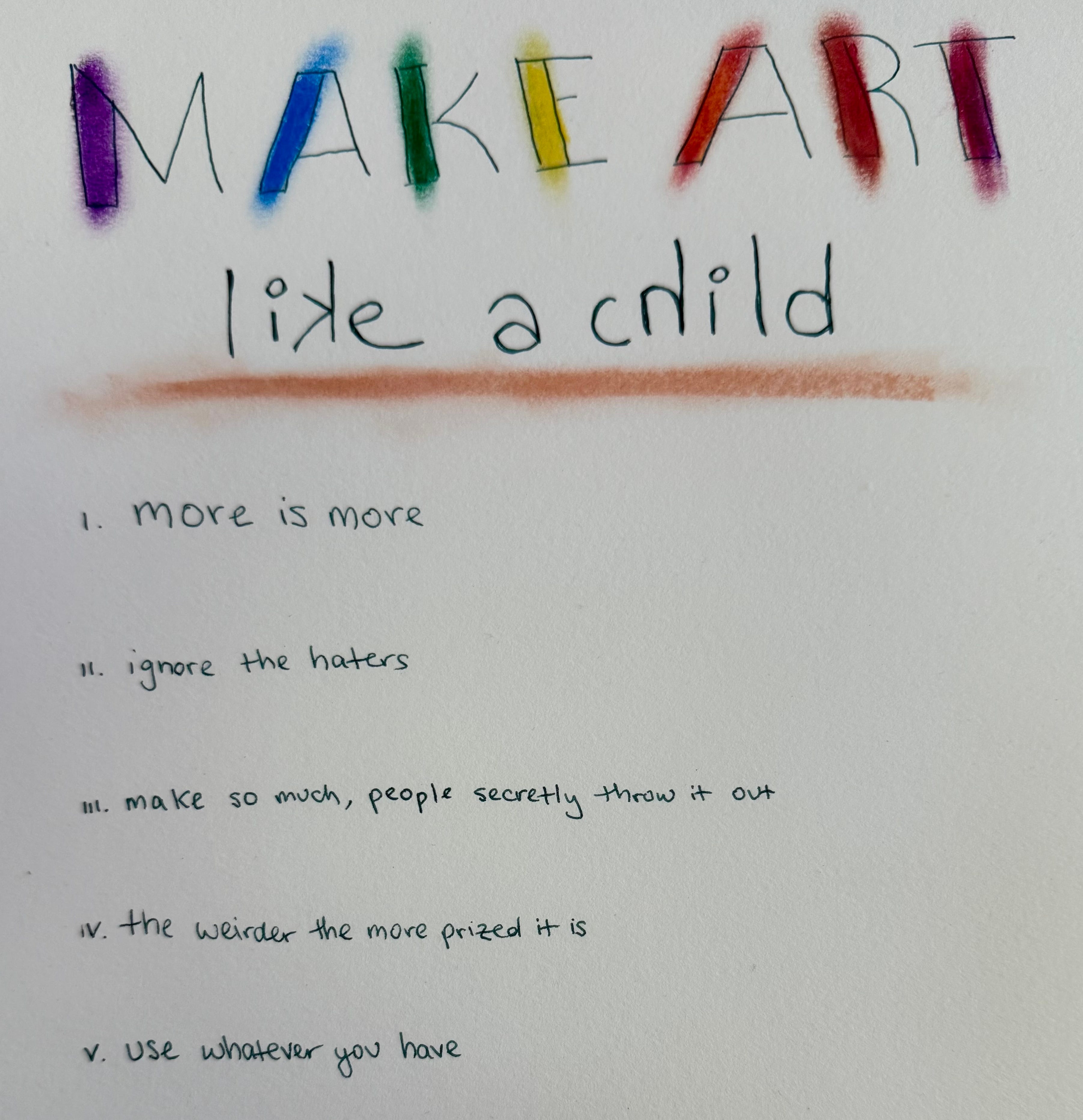
Have I considered that, if this practice is just for me, maybe I should keep it secret and not share it with people online? Yes, of course I have, and that’s my plan for 99% of what I make. But I thought it might be worth risking a bruising to share some of what I made if there’s a chance I could inspire anyone else to give this kind of creativity a shot.
Do you have an art practice? Are you curious about which art supplies, companies, and kits I’m obsessed with and which I think are totally worth passing on? Share in the comments! But be nice, please. I’m not looking for validation, but also I’m just a sensitive baby artist, so don’t say anything you wouldn’t say to a three-year-old about their wonky-ass rainbows.
THE ONLY THINGS WORTH LIVING FOR ARE LOVE AND ART
So much of this post resonated with me! Whenever I try to get back into an art practice, though, I’m plagued by extra feelings of inadequacy — I used to be quite “good” at painting, in high school when I was taking art classes every day, but it’s been so long. The thing that keeps stopping me now is feeling like I’m just not as good as I used to be. Logically, I can tell myself that’s a silly excuse and that the way to get better is to keep doing something and also that the point is not to produce something amazing but just to do it… But when I look at the watercolors and paintings I do now, I often feel ashamed at how “bad” they are compared to what I was doing when I was 16. Like I’m comparing myself to the 16-year-old version of myself and coming up inadequate.